A scent you love should feel good on your skin as well but for others, however, it is quite the opposite. They develop a reddish tinge to their skin. Their nose runs. Their eyes water. If you're like us, you've been wondering, Is this an allergy or am I just sensitive to fragrance?
These two terms can be confused. It's important to know the difference, particularly if you reside in Pakistan and wish to acquire original perfume in Pakistan without relating which bottle will hurt your skin. Both are explained in layman's terms in this guide, including symptoms, causes and protection measures you can take to keep your skin safe.
Perfume allergy occurs when your body's immune system sees a scent's components as a threat. Your body produces histamine and the chemical triggers the “classic signs” of an allergic reaction. When the body identifies an ingredient as harmful, the body reacts in the same manner the next time it comes in contact with it or smells it.
Synthetic musks, some essential oils and ingredients found in inexpensive, unapproved perfumes are common causes. Cheap and poorly made perfumes often use higher amounts of harsh synthetic chemicals in order to be more cost-effective. One of the reasons Perfume allergy symptoms occur more regularly with fake or diluted fragrance compared to authentic fragrances. Authentic perfumes go through testing that limits these ingredients to a safer level.
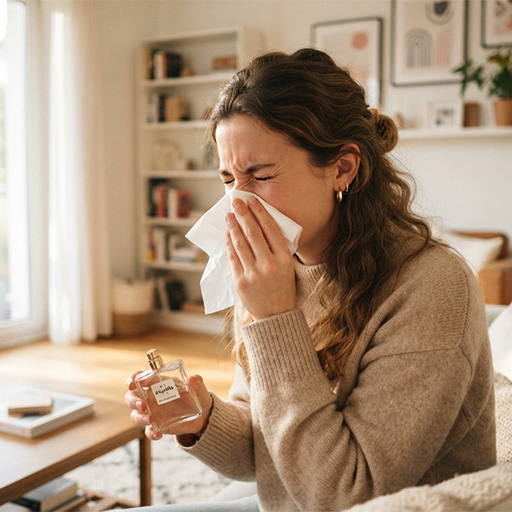
With fragrance sensitivity, that's not the case. Don't mistake this for an immune reaction. Well, it's more of an irritation. Your immune system doesn't become involved, your skin or airways does.
People with Sensitive skin and perfume exposure may not have a full allergic reaction, but feel discomfort. They may have a burning or itchy sensation in their skin. They may be sensitive to multiple aromas and get teary eyed in a room full of multiple fragrances. Sensitivities seem to develop gradually. Using perfumes at every opportunity may compromise your skin barrier, making it easier to irritate the skin in the future, even if it did not irritate you in the first place.
It's frequently small in the beginning. An area of skin after spraying with perfume gets pink, red and begins to itch continuously. In usually an hour, small raised bumps may develop, sometimes in the form of a spray pattern. This kind of Perfume skin irritation is often the first alert sign.
Several individuals may experience a flush on their skin. Others see swelling around the eyes, lips, even without touching. Your nose may do the same; it could get congested or make itchy noises like sneezes. In severe cases, the throat becomes tight and/or breathing becomes more difficult. It's your body warning you and it is not something you ought to ignore.
The main distinguishing feature between irritation and this is the length of time. Sensitivities are reduced after the product has been washed off. If a person has a true allergic reaction to perfume, the reaction may continue for some time even after the perfume has been removed.
Patch testing is by no means new. It had been used for more than a hundred years to find out what is causing a skin reaction, but is now far more precise.
Early tests were straightforward: simply apply a suspected material and watch. Eventually, dermatologists developed standard fragrance panels to be able to compare results from various clinics. Clinics use tiny discs, known as Finn Chambers, to place known doses of each substance on the skin, typically placed on the back, for 48 hours or so. Dermatologists see the skin at 72 hours or 96 hours, depending on the reaction, as some reactions can take days to show up.
These days, tests are conducted on certain perfume ingredients, not just perfume. This makes it easier for a doctor to specify which particular ingredients to steer clear of, rather than simply "perfume. A simple method that can be done at home is to put a little on your inner arm, and only let it come in contact with your neck or wrists after 24 to 48 hours have passed.
Most countries have regulations for the disclosure of common allergens on packaging at a certain concentration level. This provides customers with a true opportunity to see a product prior to putting it on their skin. Clear labelling ensures that people can avoid something that is known to aggravate them, and provides useful information to doctors at diagnosis time. Understanding fragrance ingredients and allergies starts with reading that label carefully.
There is rarely accurate labelling of the counterfeited perfumes. They do replicate the bottle and the name, but they don't include the list of ingredients, or the safety test that went into it. One of the reasons why fake perfume causes perfume irritation than the genuine ones, which are well labelled, is its relative quietness. So when you're shopping for the original perfume in Pakistan, it's better to take a safety measure than a symbol of it and check the label when you're shopping for Original Perfume in Pakistan. It’s a safety step, not just a formality.
Safety of perfume is not the only concern of the buyer. From the brand perspective, there are similar questions: What ingredients are causing reactions? How do you record them? How do you create a “real skin friendly” fragrance?
That's why buyers looking for Original Perfume in Pakistan from the start, we create products that have a clear "scent direction" and are "honestly labeled. Allergens are not dealt with when complaints begin, but before a product ever comes to contact a customer's skin. We have all the work done for the supplier verification, formula adjustment and quality checks following the actual climatic conditions and skin type of our customers.
This is our method for each and every bottle we sell. This is why the perfume buyers in Pakistan believe that Zahyre is offering an original perfume as the entire sourcing is verified, the documentation is authentic and the formulas are subjected to proper checks before reaching the shelves. Zahyre is made with the allergen safety concern first and foremost.
How to know if you are allergic to perfume?
Look out for symptoms such as sneezing, itchy/watery eyes, headaches, redness of the skin or small elevations on the skin after exposure. Symptoms manifest in minutes to hours and subside when removed from the smell.
Is there a difference between sensitivity and allergy?
Yes. Allergies are an immune reaction (usually skin reactions). Sensitivities are reactions to intense smells that may cause headaches and make you feel sick, but do not involve the immune system.
How to cure perfume allergy?
No cure exists; however, avoiding triggers, taking antihistamines and using products without fragrance will help to reduce symptoms. Consult with an allergist if reaction occurs frequently or is severe.
Am I allergic or just sensitive?
Patch test by an allergist is a sure way to know. Visible skin reactions = allergy; headache or nausea (no visible reaction) = sensitivity.
Which perfume is best for an allergic person?
Use fragrance or hypoallergenic products that contain few ingredients. If introducing a new product, patch it on first on the skin.
Where to get original perfumes in Pakistan?
You can buy original perfumes in Pakistan from trusted online perfume stores such as Zahyre. We provides genuine fragrances for men and women, in diverse fragrance kinds and preferences. When purchasing perfume online, verify the authenticity of the product, brand specifics, customer reviews, return and exchange policies before placing an order.If one is seeking original and authentic perfumes in Pakistan, then Zahyre is the website which allows you to check out its perfume collection and order any of the perfumes easily.